Roads to Maralinga, David Burns
I would like to acknowledge the Maralinga Tjarutja people who are the Traditional Custodians of the land concerned in this research, and I would like to pay my respects to Elders past and present.
Between the small coastal town of Ceduna and our destination Maralinga, the roads don’t have signs and some don’t appear to have official names. There are only a few places to stop, including a roadhouse or two and an Aboriginal community called Scotdesco that draws in tourists with a Big Thing (a wombat).1Rural Australia is dotted with so-called Big Things, super-sized representations of animals, food, or other objects, often rendered in plaster and situated at roadhouses or other tourist stops. Our directions instruct us to call from Nundroo, the last chance to use a mobile phone until the Trans-Australian Railway. Nundroo is a couple of semi-connected buildings with a roadhouse, a shuttered bar, and a few rooms for hire. We call Robin, Maralinga’s current caretaker, and he sounds exactly like I imagined: a deep Australian drawl, gruff and friendly. He says we’re close and he’ll see us in a few hours.
We’re driving on the Eyre Highway that originated in the 1870s as a by-product of the East-West Telegraph and informally connected the populous east with the mineral-rich west. We’re on the eastern edge of 180,000 square kilometres of exposed limestone, an ancient Cretaceous Period sea bed that the Indigenous Anangu called Gondiri, meaning “bare like a bone”.2Collins, Neville. The Nullarbor Plain: A History. Woodside, SA, 2008, p.2. In 1840, Englishman Edward John Eyre falsely claimed that he was the first man to cross Gondiri and another white man gave Gondiri a colonial name: Nullarbor Plain, Latin for “no trees”. Eyre’s name is now conspicuous across Australia. The Eyre Highway was considered a marvel in its day, largely because it attempted to tame the Nullarbor, but the road wasn’t completed until 1942 and even then, it was little more than a dirt track. Today, the sunburnt and pockmarked bitumen looks tired and overused.
Our first direction from Robin is a right turn off of the Eyre onto an unmarked road. Checking our maps again and seeing no road where there is now clearly a modern highway, it reminds me that well into the 21st century it’s still possible to build significant infrastructure in the Australian bush in relative secrecy. The dark flat bitumen has perfect hard shoulders and brightly painted centre lines. Later I find historic photos that prove that until very recently it was unpaved red sand. We see a road train – a single truck with multiple trailers – parked on a purpose-built side road, the driver smiles and waves. He’s the last person we’ll see for hours. No grey nomads3Grey nomads: recently retired Australians traveling the country in expensive, overly outfitted off road vehicles, often towing elaborate camping gear., no cars. Why is this road here? Our answer lies just beyond the horizon to the northeast. This road leads to – and is possibly subsidised by – the Iluka Mine, the world’s largest source of zircon. Mining is the foundation of the Australian economy and every square centimetre of land is at risk of mineral extraction.
We’re just kilometres from the southern border of the vast Woomera Rocket Range which boasts over 120,000 square kilometres of land excised from the Australian republic and surrendered to the British in 1947 for testing weapons. In the 1950s and 60s, at the height of the British testing in Australia, we wouldn’t be allowed anywhere near this road. The Eyre was a dirt track, the Iluka Mine – and all the other mines – were still decades away, and there were certainly no civilians like us freely driving around.
At the farthest southwestern point of the enormous range, just a few hundred kilometres from our current location, is Maralinga, the site of seven nuclear detonations and hundreds of highly radioactive “minor trials”. Despite the Aboriginal name, Maralinga isn’t a traditional Aboriginal village or landmark. The British chose maralinga claiming it was a local Aboriginal translation of “field of thunder”. In reality, maralinga belongs to an extinct Aboriginal language once spoken by people who lived two thousand kilometres away in the northernmost tip of Australia.4Mazel, Odette. “Returning Parna Wiru: Restitution of the Maralinga Lands to Traditional Owners in South Australia” Settling with Indigenous People: Modern Treaty and Agreement-making. Langton, Marcia, editor. Federation Press, 2008. Naming this place Maralinga was the first act of a uniquely nuclear colonial project. In addition to the construction of an entire town5Maralinga Village boasted an Olympic-sized swimming pool, a church, cinema, bars and commissaries, and a self-sufficient source of energy and water., a world-class airfield6Decades after the tests were completed and the British had abandoned Maralinga, the airfield was still in demand. NASA reportedly contacted the Australian government to secure the airfield as an emergency landing site for the Space Shuttle missions., and facilities for thousands of soldiers and engineers, Maralinga destroyed countless Aboriginal lives, permanently disrupted Indigenous modes of living, and poisoned a sacred land for thousands of years to come. All of this was completed in secret, in a place white men chose to believe was an uninhabited terra nullius.
The Eyre Highway was one of the first major settler colonial projects in this region, and comprises a large part of Highway 1 which spans the continent east to west. Its north-south corollary is the Stuart Highway, also known as The Track. Highway 1 wasn’t fully sealed until the 1970s and the Stuart Highway wasn’t completed until the 1980s. When Maralinga was established in 1953, Robin tells us that the British sealed thousands of kilometres of roads, while nearby towns and villages had no sealed roads at all. Maralinga was not only decades ahead in science, it also possessed some of the most modern civic infrastructure in South Australia. This fact is made even more incredible with the knowledge that this expansive contemporary infrastructure was invisible and unusable to the Australian public.
Back on the Iluka Mine road, the landscape has begun to change, but driving at 130kmph on the smooth new road, it’s difficult to notice. The next direction on the map notes that we’re nearing the end of the bitumen. The next road, despite its red sand, is proudly marked with multiple signs that direct us westward to Maralinga and Oak Valley. Oak Valley is even younger than Maralinga. After decades of court battles, Aboriginal peoples who were violently dislocated by the Woomera Rocket Range and the nuclear tests at Maralinga and Emu Field forced the South Australian government to acknowledge their native title, the result of which was the landmark 1984 Maralinga Tjarutja Land Rights Act. The funds secured by this act led to the creation of Oak Valley, a place that is mostly off limits to non-Indigenous visitors.
We turn off the Iluka road, the hot bitumen giving way to soft, shifting sand. We cross a dry riverbed and before us is a straight red line carved into the bush. I think of Len Beadell, the Australian surveyor and self-proclaimed “bushman” and the casual violence in his description of the making of roads similar to these. In one of his books, he recalled perching himself in the distance, using a pocket mirror to reflect the sun back at his colleague who blindly bulldozed the native scrub. Like Beadell, we carry our colonial privilege conspicuously: he with the British mandate to build his roads anywhere he saw fit and us in our air-conditioned SUV. How do we visit these lands, embedded with tens of thousands of years of Aboriginal life and culture, now overlaid with infinite radioactive damage and death? How do we confront the colonial gaze that we despise so much, knowing that it is inherent in us? How do we justify the further mediation of these lands?
We continue driving, the landscape changing at every slight rise. The bush, so famed for its relentless monotony, is rich and diverse. Despite this, the colonial presumption of the empty outback is stubborn and it’s easy to feel alone. The flatness of the terrain means we can see for kilometres, but there’s no one to see. We know we are not alone, that his land has been occupied for thousands of years, but we can’t shake the feeling. We top the next rise and onto another new terrain.
Our phones jump back to life, the railway must be ahead. In 1917, settler Australia built an east-west transcontinental railway, an achievement few thought possible. Encouraged by the 1901 Australian federation, the construction of the railway provided a reliable and relatively fast continental journey previously only possible via the turbulent Australian Bight or an almost impossible drive on the unsealed Eyre. The Trans-Australian Railway sparked a western expansion into the ore-rich lands that are now amongst the wealthiest places on Earth. When nuclear-colonial Britain arrived some fifty years later, the railway fuelled not only a new, unimaginable expansion of Britain’s influence over Australia, but also the further destruction of Aboriginal culture and traditions. Our intersection with the railway is brief. A rusty communications tower rises over the terrain, alongside an immaculately maintained set of straight rails. We’re near the beginning of the longest continuous stretch of straight track in the world. The 478km length begins in Ooldea – a traditional Southern Pitjantjatjara home – and ends in Loongana, Western Australia. The laser straight rail cutting its way through the bush, nothing allowed to divert it, nothing permitted to alter its way. These moments of infrastructural violence are everywhere. Roads carved into the bush, exposing the red earth underneath like a fresh wound. Thousands of kilometres of straight rail slicing ancient countries in half, truncating and destroying sacred songlines. Basic construction, roads and bridges, railways and utilities, all working in concert to overlay western systems of quantification on lands that had resisted for so many thousands of years.
After another hour or two in the sand, we mount another bitumen road that is much older than any road we’ve seen thus far. The edges are worn, falling away. Potholes have eaten deep craters in the surface and it’s warped from decades of heat and sun. I realise we’re on a road that I’ve studied for years, from above, traced from satellite images and maps and historical documents. This road is British, and likely one of the first. It leads directly to Maralinga. If we had turned south, the road would have taken us to Watson, a now-abandoned railway station and rock quarry that was the source for much of the raw materials that supplied the construction of the roads we’re driving on, the airfield at Maralinga, and eventually the rubble that buried the radioactive waste.
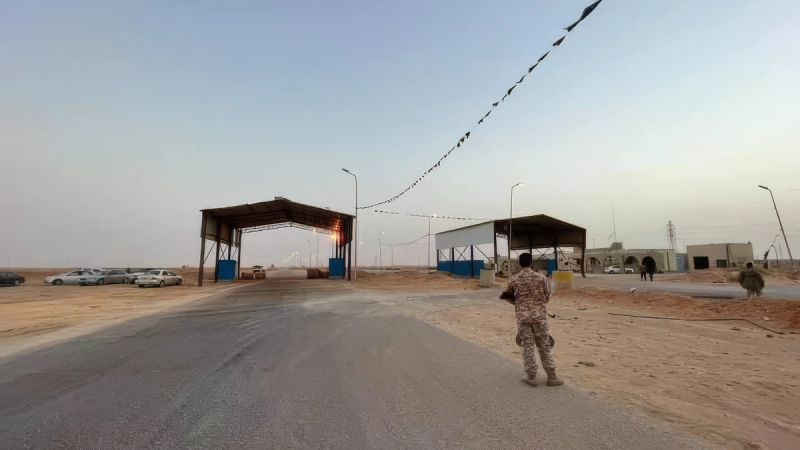
We’re ascending slowly. The old British road pulling us up from the ancient seabed of the Nullarbor to the deep sand of the Ooldea Range. Our drive ends with stark warnings of radiation and a chain link fence. Robin is waiting on the other side. The fence, now just a formality, extends only twenty metres from the gate on either side. The anti-nuclear protests from previous decades are over, no one is trying to break into Maralinga anymore, and the Maralinga Tjarutja have made it clear that they welcome visitors and the historical weight the site now contains. We stop nonetheless, out of respect for the new (old) custodians of this highly mediated land. This is now – as it always was – Maralinga Tjarutja land.
text, essay
AA Files (2021)
Keywords: , ,