An Unseen Archive of Nuclear Colonialism, David Burns
I would like to acknowledge the Maralinga Tjarutja who are the Traditional Custodians of the land concerned in this research, and I would like to pay my respects to Elders past and present.
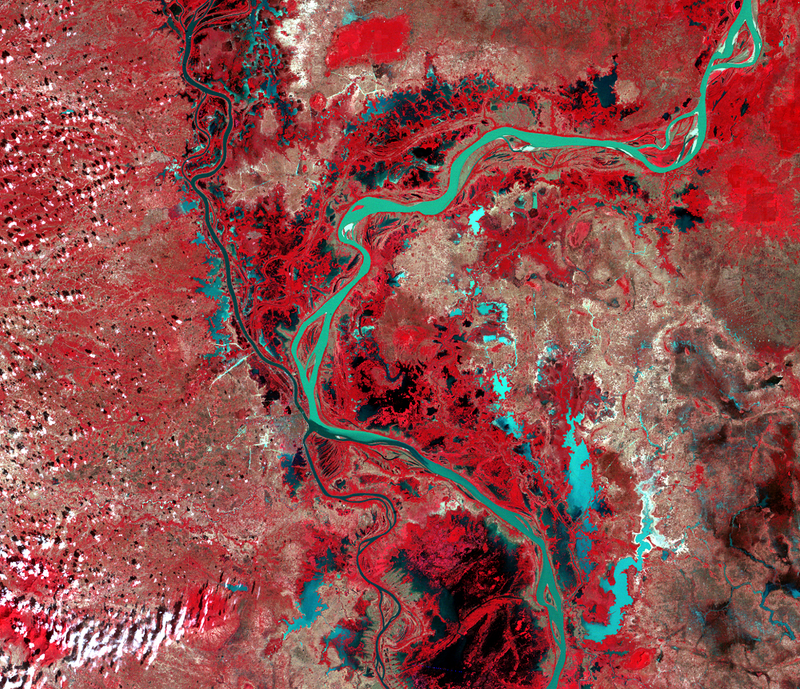
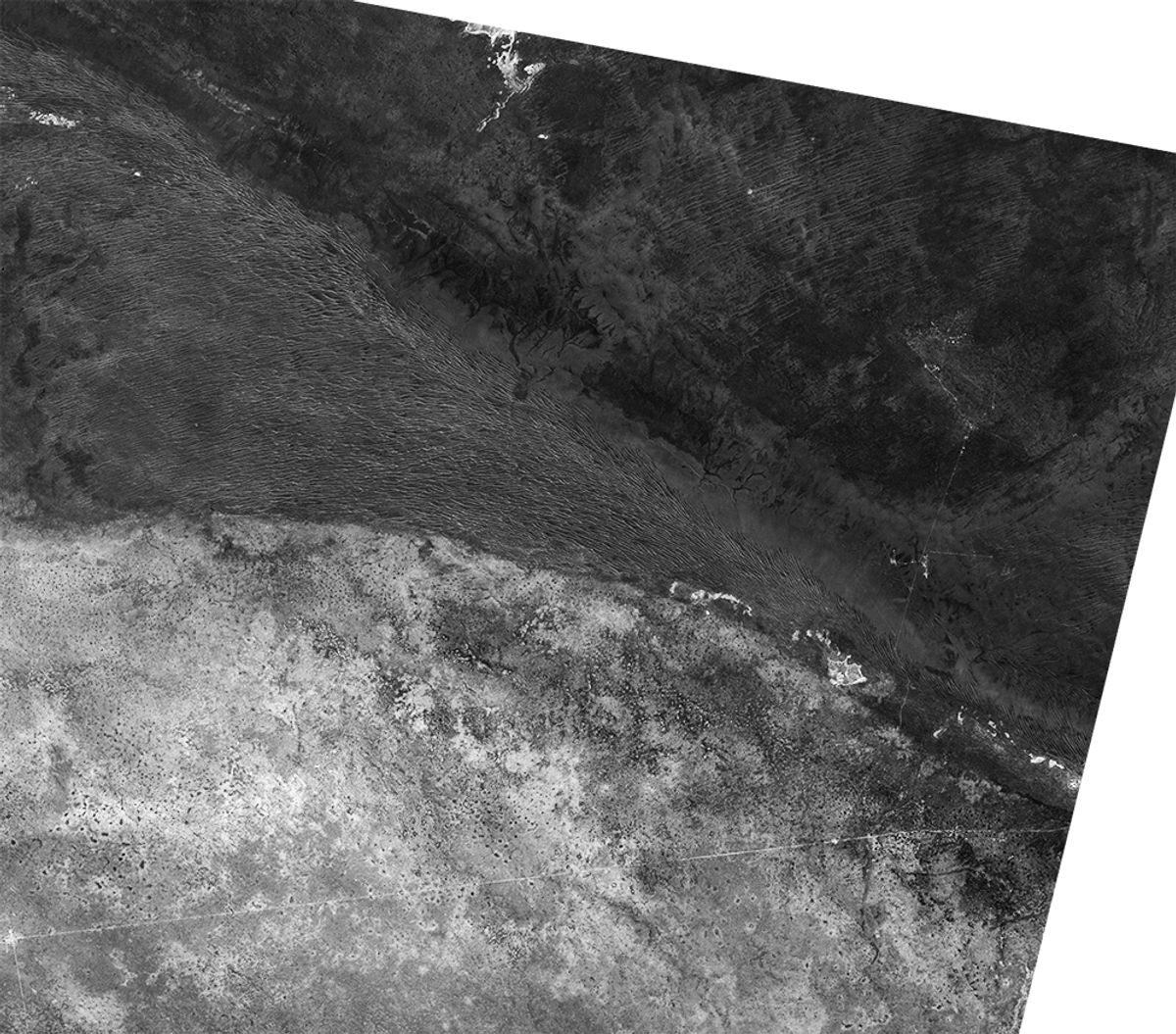
From above, high above, hundreds of kilometres above, Maralinga is stubbornly invisible. The pale, mottled Nullarbor Plain dominates the southwest. The Ooldea Range to the northeast appears disturbed and banded. Prominent infrastructure slices unnaturally from west to east. This land could be anywhere, but probably not Australia. Where is the flat desolation? Where is the empty nothingness? Hundreds of years of colonial proclamations of terra nullius confuse the reading of this satellite photograph. Vilém Flusser’s Towards a Philosophy of Photography may help us to decode. He explains that due to its mode of production, the technical image is the “final link in a causal chain” (Flusser, 2000: 14) between the world and the image’s significance:
This apparently non-symbolic, objective character of technical images leads whoever looks at them to see them not as images but as windows. Observers thus do not believe them as they do their own eyes. Consequently, they do not criticize them as images, but as ways of looking at the world …Flusser, Vilém (2000), Towards a Philosophy of Photography. Reaktion Books, p.15.
This Landsat satellite image from 1990 challenges colonial assumptions about how this part of the world should appear, how it should or should not function, and what should be visible to the viewer. A predisposition towards viewing the Australian outback as a conceptual – and actual – void overrides our trust in our own eyes. Our “ways of looking at the world” tell us what to see, tell us how to see it, and tell us how to act upon what we think we see. Flusser makes a distinction between traditional images and technical images by their levels of abstraction. A technical image is a third-order abstraction: “They abstract from texts which abstract from traditional images which themselves abstract from the concrete world.”Flusser, 14. We normally do not interpret satellite images as an abstraction of anything. We view them through our screens as though we are physically there, silently hovering and observing like an anthropomorphised drone. The satellite image, however, is always a conflation of concepts: the distraction of distance and perspective, the contradictions of complicity in military histories, the production of state politics, and the growing intellectual conflict in the fact that most images are created to be seen only by other machines. Or as Laura Kurgan via Lisa Parks warns, the satellite image “resists sovereign control and opens itself to other sorts of interpretation.”Kurgan, Laura (2013), Close Up at a Distance: Mapping, Technology, and Politics. MIT Press, p.30. The satellite image is a remote construction that packages conflicting historiographies by enforcing the colonial claims on what is visible and to whom.
What this particular satellite image does not disclose, however, is the evidence of the Cold War trauma that Maralinga experienced. What exists in the images of Maralinga, although frustratingly unseen, is what anthropologist Joseph Masco calls the “multimillennial colonisation of the future”.Masco, Joseph (2006), The Nuclear Borderlands: The Manhattan Project in Post-Cold War New Mexico. Princeton University Press, p.30. The product of years of atomic research and testing – invisible in this image yet still present and essentially eternal – is interred in burial pits, vitrified in glass, or hidden in plain sight as seemingly harmless rocks and sand. Maralinga is the result of a politics of repeated and layered forms of colonialism and environmental destruction, the evidence now buried underfoot, defying the omniscient satellites above. Maralinga has become an unseen archive of nuclear futures imaginaries.
Terra Nullius
We are to consider that we see this country in the pure state of nature; the Industry of Man has had nothing to do with any part of it, and yet we find all such things as nature hath bestow'd upon it in a flourishing state.”Cook, James, Hutchinson, John, Wallis, Samuel and Bolckow, Henry William Ferdinand (1768), Journal of H.M.S. Endeavour. Web. 23 July 2018 nla.gov.au/nla.obj-228958440
Throughout the contested historiographies of Australia, repeated colonial tropes of the unseen, the void, and indeed terra nullius, or “nobody’s land”, are pervasive. James Cook, in the diaries from his initial 1770 landing on the continent, established the colonial blindness that would be echoed by countless future British “explorers”. The land appeared to them as the “pure state of nature” and the ideal territory for a new colony for the British empire. The inability to see, or more accurately, the ability to deny what is easily observable is the basis of Australian settler colonialism. Sixty-five years later, on 26 August 1835, only a few kilometres from where Cook invaded the Australian continent under orders of the British Crown, New South Wales Governor Richard Bourke signed a two-page proclamation that officially opened the Australian continent to naked conflict between a visible and deadly coloniser and a now invisible and expendable Indigenous population.
Now therefore, I, the Governor, in virtue and in exercise of the power and authority in me vested, do hereby proclaim and notify to all His Majesty’s Subjects, and others whom it may concern, that every such treaty, bargain, and contract with the Aboriginal Natives, as aforesaid, for the possession, title, or claim to any Lands lying and being within the limits of the Government of the Colony of New South Wales… is void and of no effect against the rights of the Crown.”Proclamation of Governor Bourke (10 October 1835), National Archives of the United Kingdom.
Bourke was responding to a series of conflicts about land ownership, to a rising resistance among Indigenous peoples against the steady expansion of white settlers into Australia, and specifically to a recent “treaty” signed by pastoralist John Batman and a contingent of Wurundjeri elders on 16 June 1835. The document, later known as Batman’s Treaty, recorded the sale of the land around Port Phillip (contemporary Melbourne, Victoria) to Batman, and by default, recognised the previous Aboriginal ownership. Just two months after the signing of Batman’s Treaty, Governor Bourke issued the proclamation voiding this sale and any other agreement with Aboriginal people. This is terra nullius, or as Karen Barad has offered, the “void – a much-valued colonialist apparatus, a crafty and insidious imaginary”.Barad, K. (2017), "No Small Matter: Mushroom Clouds, Ecologies Of Nothingness, And Strange Topologies Of Spacetimemattering", in, Anna Tsing et al., Arts of Living on a Damaged Planet: Ghosts and Monsters of the Anthropocene, Minneapolis: University of Minnesota Press. An imaginary based on the arrogance to assume the void and to bring destruction and contamination via nuclear radiation at Maralinga. The nuclear detonations created a new – and quite literal – terra nullius, metastasised and projected onto untold future generations.
Too Straight, Too Long
Too straight and too long, a line in the landscape reveals Maralinga. Almost. This line isn’t British, at least not directly. This is the Trans-Australian Railway. Constructed at the apex of Australia’s push for federation, a time of heightened white nationalism, the railway was a proud moment for white settlers as they compulsively pushed the Australian frontier farther and farther into the desert. This image observes the railway in its most literal colonial expression: hundreds of kilometres of perfectly straight track. Overlaid onto, yet barely engaging the terrain, the railway contrasts sharply with the land on which it sits.
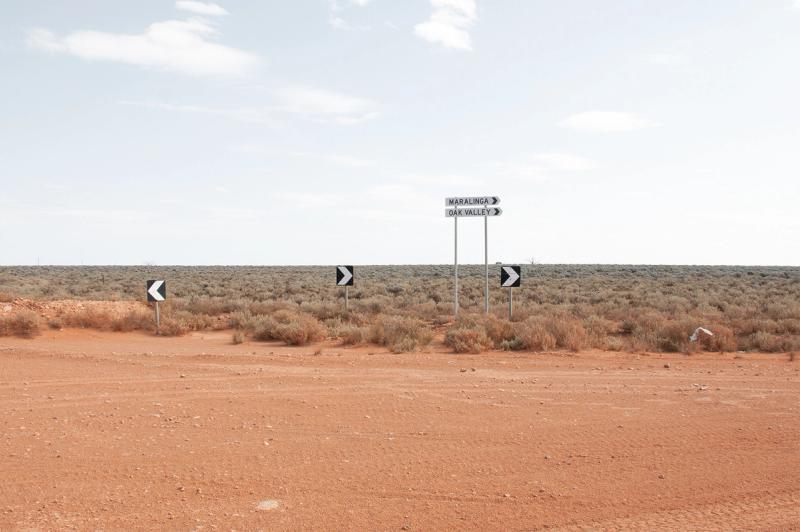
If we zoom in one more step, a single road appears, conspicuously disconnected from the two-lane, cross-country road following the southern edge of the continent. The first evidence of British nuclear colonialism, one road becomes two, then five. An angular grid emerges that stretches out into the distance; a misplaced modern infrastructure. Evidence of hasty British remediation pockmark the southern section of the grid; the deep colouration of the land is rubbed pale, exposing the limestone below. The ruins of a small village become legible. To the south, two miles of tarmac oriented due north-south, an airstrip engineered to accommodate the largest transport aircraft in the Royal Air Force.
From 1953 to 1967, the British military maintained a semi-secret, semi-sovereign, extraterritorial state within a state in the farthest southwest corner of South Australia. Originally designated X300, it was eventually renamed Maralinga, a word that the British claimed was a local Aboriginal translation of “field of thunder”. In reality, maralinga belongs to an extinct Aboriginal language once spoken by people who lived two thousand kilometres away in the northernmost tip of Australia.Mazel, O. (2008), Returning Parna Wiru: Restitution of the Maralinga Lands to Traditional Owners in South Australia, in, Langton, Marcia, editor, Settling with Indigenous People: Modern Treaty and Agreement-making, Federation Press, p.169. The local Anangu word for thunder is tuuni. (Mattingley, 2016: 27)
Thousands of engineers, scientists, soldiers, pilots, and photographers established a self-sustaining world in the Australian outback. Hundreds of buildings were constructed from leftover WWII aluminium flown in from British military bases overseas. Elaborate water collection systems were built to avoid conspicuous and vulnerable pipelines. Quarries were dug to harvest sand and stone for concrete. At a time when the primary roads crisscrossing the Australian continent were still red dirt, Maralinga boasted a vast grid of smooth bitumen. They laid communication networks, installed advanced optical devices, and exposed millions of feet of photographic film. They tested rockets and missiles and even launched a satellite into orbit. They detonated nuclear weapons.
Taranaki
As we move closer, we advance the clock several years. In the northwest we see a large discoloured site, an open wound. This is Taranaki, only a few years after the remediation of the late 1990s. Taranaki was the site of the worst of the tests, including the final and largest nuclear weapon detonation at Maralinga on 9 October 1957 and hundreds of so-called minor trials. These trials, though not as pronounced or detectable as a weapons test, produced the greatest contamination. The final remediation at Maralinga involved a variety of government and private agencies, and witnessed a dramatic reconfiguring of the physical properties of the land. The primary operations focused on areas with plutonium contamination and the land ploughed during Operation Brumby, the botched British attempt at remediation.
Dozens of British burial pits containing plutonium and radioactive waste were identified, including twenty-one in the Taranaki site alone. Another seventy-six informal British pits were discovered during the process. Some were excavated and re-interred in new trenches while others were melted into building-sized glass blocks via a process called in situ vitrification. The largest pit is located at Taranaki and is called the Taranaki soil burial trench.
This trench was one of the first dug at the site and was capped on 3 October 1997. Its dimensions are 206x141m at a depth of 15m with a 5m cap of fresh soil. Inside the limestone and granite vault is 262,840 m3 of contaminated soil. On the ground, the pit is difficult to comprehend. The edges of the pit are neatly chamfered at forty-five degrees and rise three to four metres. Small trees are sprouting on top thanks to a robust reseeding initiative in the final stage of the remediation. A small PVC pipe protrudes from the middle of the western edge of the large trench used to periodically check the pit for evidence of leaching into the porous limestone.
The remediation was commemorated with the erection of concrete monuments. Each of the major burial trenches has a corner plinth, wedge-shaped, two-sided concrete warning signs. The plinths measure 2m x 2m, and 0.7m in height. The side facing away from the trench has a radiation symbol and the words “WARNING BURIED RADIOACTIVE MATERIALS”, plus the date of burial and the warning of “NO CAMPING / NGURA WIYA”. The opposite side features a drawing with coordinates of the corners of the trench. The words on each side of the plinth are cast into the concrete, but only into a thin veneer of precast concrete. The panels are then attached to a wedge-shaped concrete block poured on site. Accompanying the plinths are metal signs with more information, erected at each corner of the main trenches. Compared with the longevity and resilience of the materials inearthed, the plinth and signs seem ridiculous.
While these objects have a limited lifespan, there are other monuments at Maralinga. Monuments that are inearthed under metres of foreign soil, interred in vast granite and limestone crypts. They are the material evidence of not only the tests, but also of the petty political bickering between a fading colonial power and her confused, subservient protégé. Future nuclear archaeologists may find evidence that Maralinga had undergone several remediation attempts, each only slightly more comprehensive than the prior, each failing to remove the threat. The nuclear tests in Maralinga created unintentional and distinctly material-media monuments that despite their relative isolation and recent interment will manufacture a steady beacon of remembrance, limited only by the 24,000-year half-life of plutonium. The hundreds of thousands of cubic meters of soil and radioactive materials create a timeless connection between generations and an uncertain and deadly future. The burial trench embodies a permanence that the mushroom cloud could never achieve: an eternal monument, a horizontal earth work at the scale of the cloud. Now, what once was atmospheric is subterranean.
text, paper
II International Congress - Colonial and Postcolonial Landscapes: Architecture Colonialism War (2023)
Keywords: colonialism, Australia, nuclear