Digital Building Blocks, Manja van de Worp
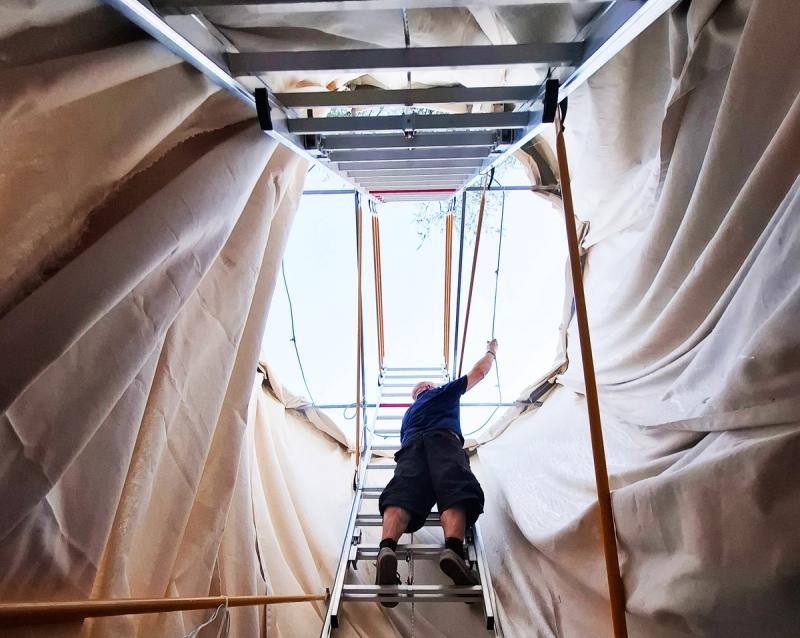
Digital Building Blocks: Tallinn Art Biennale pavilion a methodology for multistate structural design. Manja van de Worp.
Multi-state design is a unique sustainable structural design method that reduces the environmental impact of structures. Traditionally, structural design develops a single design with the aim to minimise material quantities or use low-impact materials. Multi-state structures reuse structural components over multiple service lives and in different layouts. This creates a new form of lightweight design, which in building construction is rarely used, in which elements can be reconfigured over time to adapt the whole building to changing needs. This means the structural elements have to change function too, i.e. need to change their
structural performance over their lifetime. In order to allow for this change in type and magnitude of force, we do not rely on standard structural typologies such as beams or columns when analysing these structures, but on “blocks” that together at a certain moment in time can be clustered to become a column and at other times a beam, i.e. we consider specific but changing load resistance at various moments.
The design method utilises a concept of structural elements that can become different in degree (as in the game of Go), in which their performance is based on the relation between neighbouring elements, whereas traditionally elements are designed to be different in kind (like chess pieces) and are embodied as performance embedded
in a common type, as described by Reiser and Umemoto in their Atlas of Novel Tectonics (2006)