The Event of Archaeology
People
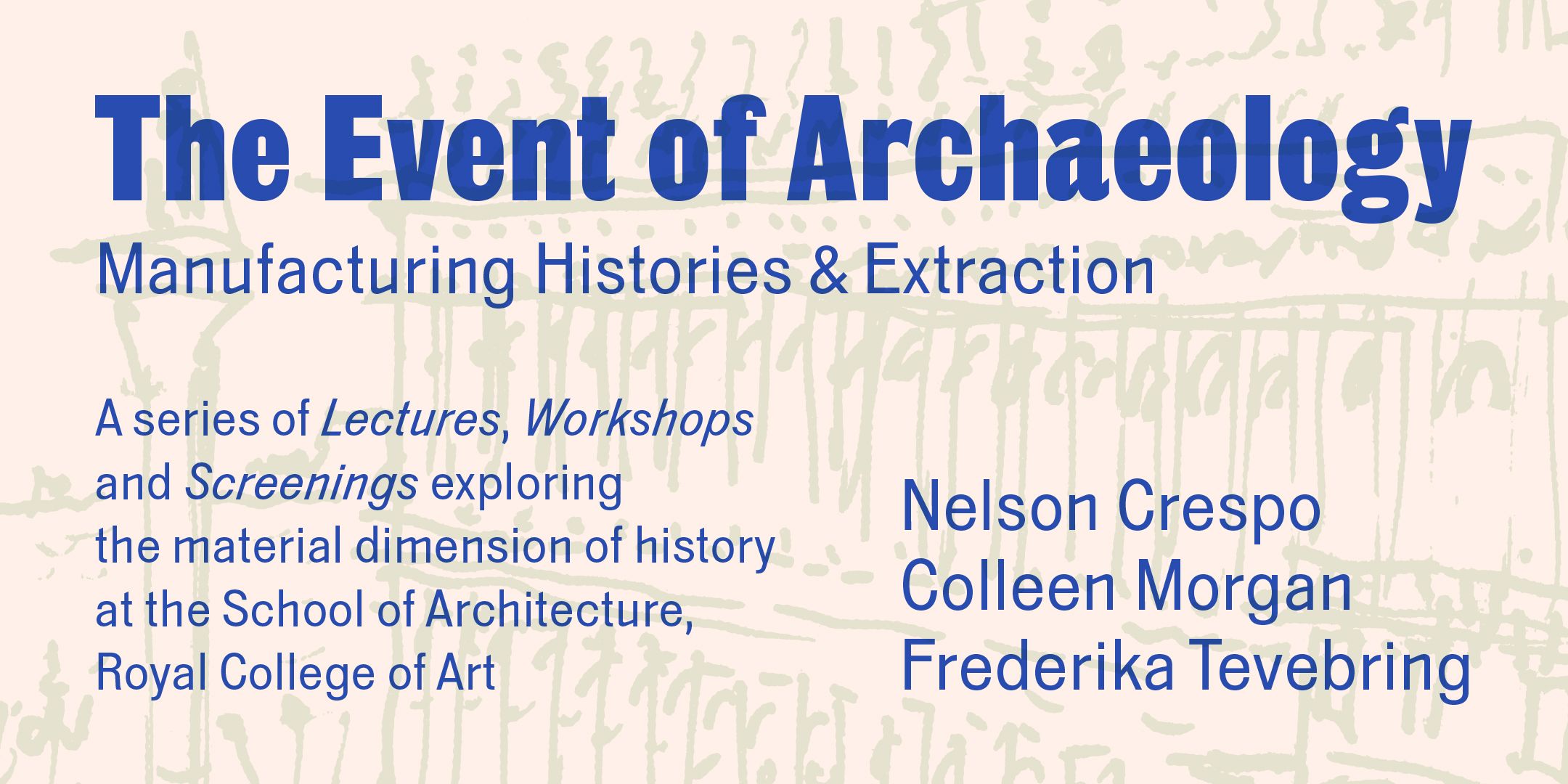
A series of lectures, workshops and screenings at the School of Architecture (2024) Royal College of Art, organised by Ines Weizman and research students of the MPhil/ PhD Programme
Archaeology is the material dimension of history. Events are read from objects, traces, spaces and their relation to one another. Events could be personal, political, or personal-that-is-political, but they could also be environments. As environments are constantly evolving, they have a history, and as they bear upon architecture and material culture, they also have an archaeology. The event of archaeology is both a proposition and a method. A proposition, because what is to be studied is change rather than the object itself. A method, because this demands a different form of attention and mode of analysis.
Traditional notions of archaeology are about excavating and revealing what is deep underground, underwater, or hidden beneath thick layers of ice or sediment. Environmental archaeology instead looks at the earth, the ice and sediment as resources for reconstructing knowledge.
Architecture as the “event of archaeology” is to look at the history of climate change as being intricately connected to social change. Climate events, natural disasters, wars and histories of preservation and manufacturing are being registered in the materiality—organic or inorganic —of our environment, in architectures, cultural artefacts and the aggregate that covers them.
These might be registered in the ancient ruins of Pompeii, in the pigments of wall paintings, in the botanical source of paint, or in the ecology that produced the plants that were mixed into it, and what these plants and their availability can reveal about living conditions, diet, environments.
If there is climate, there is climate change; nothing ever rests; everything that changes is political or bears upon it; everything political intersects with issues of feminism, racism, of class, of capital. The event of archaeology allows us to travel along vectors of scale and to turn across connected historical narratives, like hinges, in order to explore different strands.
This series of panel discussions brings together archaeologists, theorists, artists and architectural practitioners to reflect on archaeological sites that at certain moments in time have revealed a particular laboratory or theatrical field of analysis that mediates micro- and macro-history, from the microscopic detail of materials to the problem of global climate change.
The event of archaeology refers to the event of discovery: an artefact or an archaeological field is revealed through natural processes, large-scale engineered extraction projects, or through new insights and research. It also comprises the moment of preserving and manufacturing replicas and imitations of artefacts, with or without the impact of war or violent conflict on archaeological sites. In such situations, artefacts and architecture are precariously revealed within political and economic frameworks that disguise their interests behind concerns for climate action.
The Event of Archaeology
- 8 February 2024: ‘Manufacturing Histories & Extraction’
- 8 February 2024: ‘The Aesthetics of Extraction, or Colour Pigments Extinct’
- 29 February 2024: ‘Colour Investigations & Reparation’
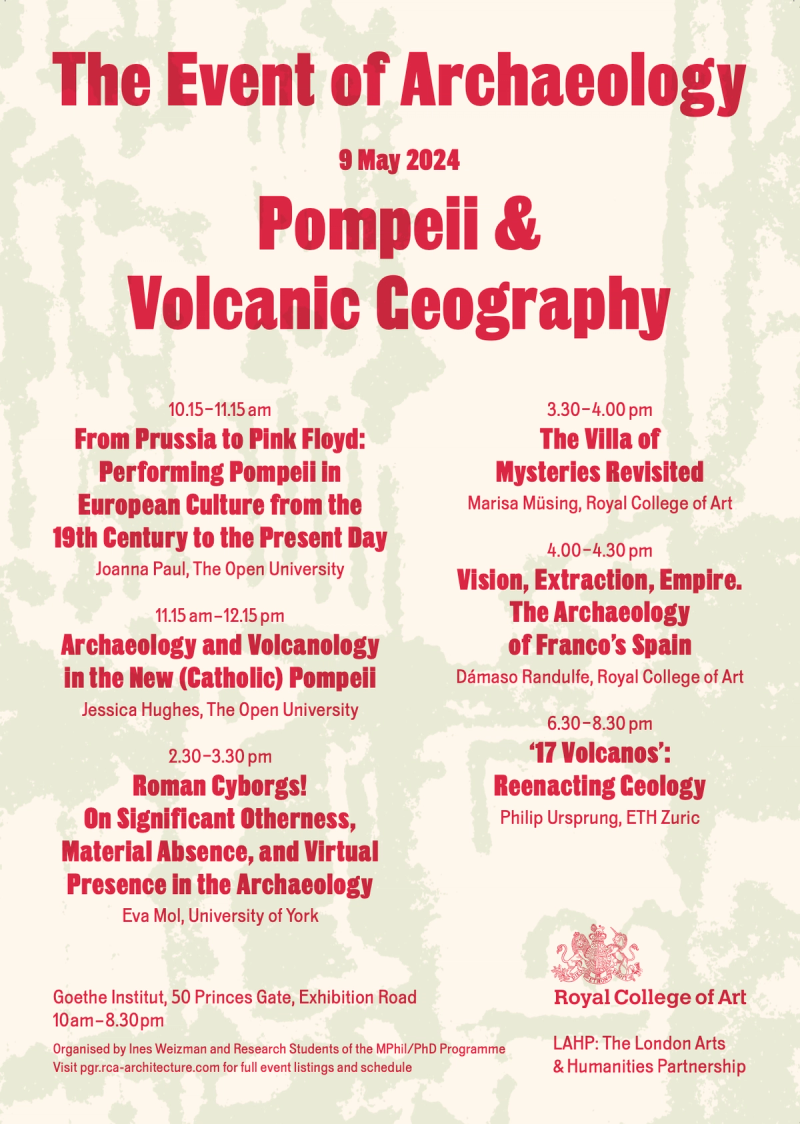
- 9 May 2024: ‘Pompeii & Volcanic Geography’